By Zainab Bakare, Mardiyyah Abubakar
Former Central Bank of Nigeria Governor, Sanusi Lamido Sanusi, has questioned the feasibility of the proposed ECOWAS single currency, ECO, and Nigeria’s ambition to build a one trillion-dollar economy by 2030, warning that political aspirations must be supported by economic realities.
Sanusi spoke at a public lecture on “ECO Currency and Monetary Integration in West Africa: Implications for Nigeria” organised by the National Institute for Legislative and Democratic Studies (NILDS) in Abuja.
He said there is often a disconnect between political declarations and the assessments of economists and central bankers. “There is nothing wrong with a common currency; that’s an aspiration. There is nothing wrong with having a vision,” Sanusi said.
“Sometimes you have a serious disconnect between statements by political leaders and the views of central bank governors.”
The former CBN governor also questioned the Federal Government’s target of growing Nigeria’s economy to one trillion dollars by 2030, arguing that current economic growth rates do not support such projections. “A year ago or two, Nigerian government officials said we want to have an economy with a one trillion GDP by 2030,” he said.
“Now GDP then was about 250 billion dollars. For you to get to one trillion in 2030, your economy is going to have to grow year-on-year at 36 per cent. The growth rate of the Nigerian economy in the first quarter was 3.89 per cent. Now, is that a vision or hallucination?”
Despite his concerns, Sanusi said he supports the idea of a common West African currency but cautioned against unrealistic deadlines. “It is not at all any kind of criticism of the common currency. I think as an end game, it would be good,” he said.
“But every time African heads of state sit down, they want the ECO in 2027 or some other date. Today, the focus is shifting from deadlines to readiness.”
Sanusi stressed that Nigeria’s economic performance would determine the success of any regional monetary union. “Nigeria is about 60 per cent of the GDP and about 70 per cent of the population of the region. If Nigeria gets it right, West Africa gets it right,” he maintained.
Meanwhile, the Speaker of the House of Representatives Rt. Hon. Abbas Tajudeen has pledged legislative support for the proposed ECO currency.
Representing the Speaker of the House of Representatives, Dr. Abdullahi Ali said a common currency aligns with the vision of ECOWAS founders who saw economic integration as a pathway to political stability and development.
“For Nigeria, the largest economy in the region, the stakes are high, a unified currency promises easier trade, reduced transaction costs and deeper market integration.” he stated
He, however, acknowledged that monetary integration requires fiscal discipline, policy convergence and strong institutions. “The National Assembly will play its part. We will bring legislative backing, oversight and policy support to ensure that Nigeria’s engagement with the ECO currency is strategic and beneficial,” he added.
in his remarks, the Director-General of NILDS, Professor Abubakar Sulaiman, called for evidence-based policymaking, saying Nigeria’s position on the ECO currency should be guided by research, strategic foresight and national interest.
Earlier, the Acting Director of the Department of Economic and Social Research at NILDS, Dr. Augustine Osigwe, said the public lecture was organised to encourage informed discussions on monetary integration and its implications for Nigeria and the sub-region.
Stakeholders Call for Economic Readiness
In his goodwill message, Sierra Leone’s Deputy High Commissioner to Nigeria, Major General Dauda Alpha (Rtd.), described the discussion as timely. “The discussion is timely and relevant as monetary integration has far-reaching implications for trade, investment, economic stability and sustainable development within the sub-region.”
Also speaking, Special Adviser to the Minister of Industry, Trade and Investment, Dr. Tochukwu Nwachukwu, explained that the success of the ECO should be measured by its economic benefits. “The objective cannot be a common currency for its own sake”
“It must support more efficient trade, reduce the costs and uncertainty of cross-border transactions and improve the ability of West African businesses to operate at scale.”
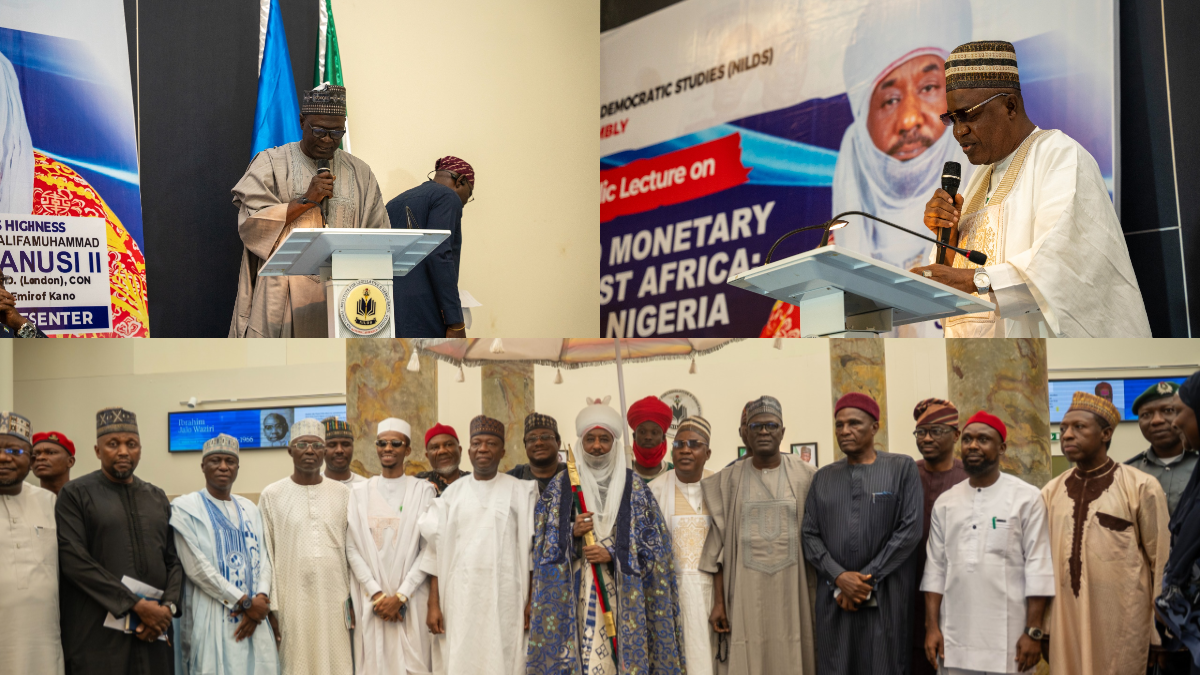
Representing the Office of the Vice President, IIklaga Fred questioned whether the region had addressed critical economic fundamentals before adopting a common currency. “Do we need to really look at the ECO currency? What should come first? Is it trade?” he asked.
On his part Chairman of the Senate Committee on the North-West Development Commission, Senator Ibrahim Shekarau, urged policymakers to consider Nigeria’s strategic position within the regional economy. “Whatever decision we take must factor in the larger picture so that the interests of the people will be taken into consideration,” he said.