By Julian Osamoto
Early results from political party primaries ahead of 2027 general election are raising fresh concerns over the exclusion of women from elective positions, despite repeated promises by political leaders to improve female representation.
Civil society organisations monitoring the process say many female aspirants are being screened out, pressured to withdraw or excluded through internal party arrangements, limiting their chances of emerging as candidates.
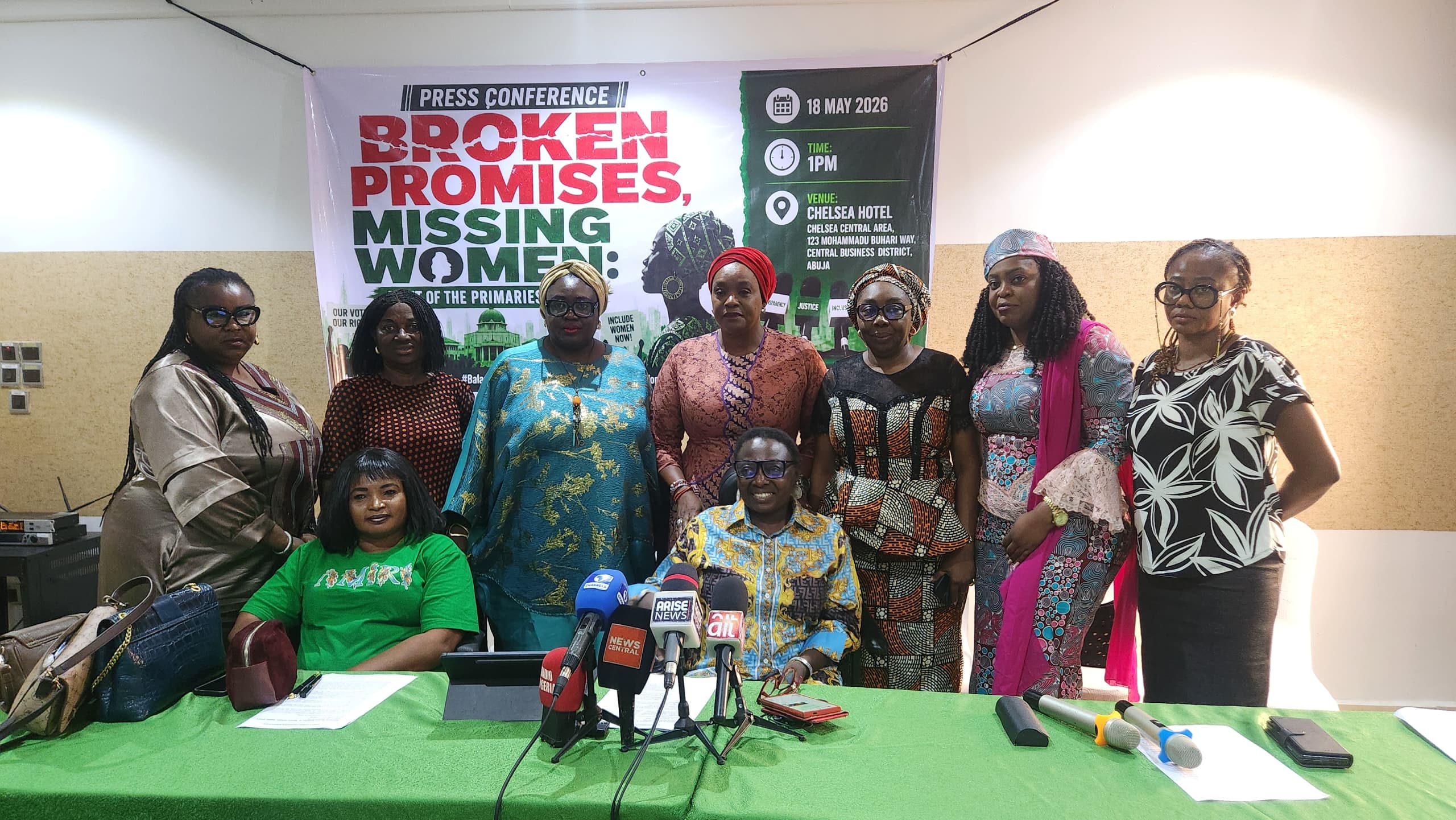
The concerns were raised on Monday in Abuja, during a news conference themed “Broken Promises, Missing Women: Audit of the Primaries So Far,” organised by a coalition of women’s rights and pro-democracy groups.
Speaking on behalf of the coalition, Toun Okewale of the Voices of Women Empowerment Foundation said the outcome of the primaries would test the commitment of political parties to inclusion ahead of the 2027 elections.
Assurances by President Tinubu
She recalled previous assurances by President Bola Tinubu and the Nigeria Governors’ Forum to increase women’s participation in governance at national, state and local government levels.
According to Okewale, those commitments created expectations that the current electoral cycle would produce more female candidates across political parties.
However, she said preliminary outcomes from the All Progressives Congress (APC) primaries suggest that women continue to face significant barriers.
“Only a handful of states, including Katsina, Edo, Imo, Ogun, Abia and Benue, produced successful female candidates in the APC primaries”, she said.
“These developments are inconsistent with the promises made to Nigerians on inclusion and equal political participation,” Okewale stated.
She alleged that several women were edged out through disqualifications, screening processes and internal political pressure designed to favour consensus arrangements.
Okewale also called on the media to increase visibility for female candidates by highlighting their achievements and giving them balanced coverage comparable to their male counterparts.
“We want the media to support female candidates by reporting them fairly and positively,” she said.
Ongoing primaries
President of the Women in Politics Forum, Barrister Ebere Ifendu, said the ongoing primaries had been shaped by “targeted screening decisions and intense internal pressure” against female aspirants.
She cited the disqualification of Rivers West Senator and former Deputy Governor, Dr. Ipalibo Banigo, by the APC Senatorial Screening Committee in Rivers State.
“Banigo is one of only four serving female senators in the 10th National Assembly”.
Ifendu also referenced the screening out of Engineer Noimot Salako in Ogun State and reports that several women across different states were pressured to step down in favour of consensus candidates.
Option A4 open-ballot voting
In Imo State, she noted that the APC’s adoption of the Option A4 open-ballot voting system resulted in major upsets involving ranking lawmakers, including Miriam Onuoha, Chairperson of the House Committee on TETFUND.
“As the APC continues to collate and ratify results nationally, other parties still have the opportunity to turn their forthcoming primaries into a genuinely inclusive democratic process,” Ifendu said.
She urged political parties yet to hold primaries, including the Labour Party, African Democratic Congress (ADC), Social Democratic Party (SDP), National Democratic Congress (NDC) and Action Alliance (AA), to ensure transparent and inclusive candidate selection processes.
“For the Labour Party, ADC, SDP, NDC and AA, the primaries are still ahead. This is their window to turn commitments into candidacies,” she added.
Ifendu argued that political will should be measured by the number of women who eventually appeared on ballot papers rather than public speeches or conference communiqués.
“Political will means using party structures to level the playing field and refusing to let qualified women be filtered out through informal gatekeeping and political settlements,” she said.
Also speaking, President of the League of Women Voters of Nigeria, Irene Awunah-Ikyegh, noted that stronger female participation would improve democratic credibility and governance outcomes.
Women Underrepresentation
According to her, women account for nearly half of Nigeria’s population but remain significantly underrepresented in the political system.
“Women are 49.7 per cent of Nigeria’s population but remain under-mobilised politically,” she said.
Awunah-Ikyegh argued that women candidates often expand voter participation by attracting women, first-time voters and families concerned about issues such as healthcare, education, food security and community welfare.
She also maintained that parties perceived as inclusive enjoy stronger public trust and are less associated with violence and vote-buying.
“Parties that give women a real chance do not weaken themselves politically; they strengthen their electoral advantage,” she said.
The coalition called on political parties to publish clear criteria for candidate selection, disclose gender representation statistics at every stage of the primaries and prevent qualified women from being excluded through informal arrangements.
“The time for course correction is now,” the coalition said, warning that promises of inclusion risk becoming “only a talking point” ahead of the 2027 elections.