By Oluwakemi Kindness
Media leaders, human rights advocates and democracy experts have called for a new ethical framework to guide the reporting of religion in Nigeria, warning that sensational coverage, political manipulation of faith and misinformation threaten social cohesion, constitutional rights and democratic governance.
The call was made on Monday at a breakfast dialogue on “Religion and Freedom of Religion in Media Reports in Nigeria” in Abuja, where participants urged journalists to prioritise accuracy, context and accountability when reporting religious issues.
Chief Executive Officer of the Centre for Journalism Innovation and Development (CJID), Dapo Olorunyomi, in his keynote address proposed a charter on religion reporting, describing it as an ethical covenant for journalists, editors, religious leaders and technology platforms.
He said the framework would promote what he called “faith journalism” a professional approach that reports religion with constitutional fidelity, editorial independence and ethical responsibility rather than sensationalism.
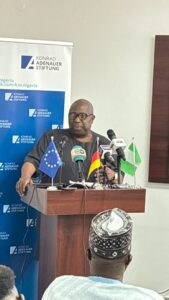
“Nigeria’s democracy needs a new professional ethic for reporting religion. I propose that we could call this faith journalism,” Olorunyomi said.
According to him, faith journalism does not seek to defend religion or shield religious institutions from scrutiny but to ensure reporting reflects constitutional values, professional rigour and public accountability.
“It is a disciplined, independent, constitutionally grounded practice of reporting religion with the rigor, literacy and moral seriousness that the subject demands,” he said.
Olorunyomi said the proposed charter would require journalists to prioritise truth over speed, report context instead of conflict, distinguish genuine religious practice from exploitation of faith, uphold the dignity of every citizen and hold religious institutions accountable like other centres of power.
He argued that Nigeria’s Constitution provides the strongest foundation for reporting religion because it guarantees freedom of religion, freedom of expression and the media’s responsibility to hold power accountable.
He warned against reducing complex national issues to Christian-Muslim narratives, saying such reporting weakens democracy by ignoring whether public institutions acted fairly and within the law.
“A journalist who compulsively frames a dispute in the character of Christian versus Muslim subverts the fundamental democratic position,” he said.
Olorunyomi also cautioned against conflict-driven headlines, saying editorial choices—from headlines and sources to story framing—shape public perception and can either deepen divisions or strengthen public understanding.
“Truth is not only factual accuracy. It requires proportion, context, intellectual rigor and honesty,” he added.
He urged news organisations to strengthen fact-checking, digital verification, open-source intelligence, geolocation and forensic skills to counter misinformation, while calling on religious institutions to promptly correct false statements attributed to their leaders.
For the Resident Representative of the Konrad-Adenauer-Stiftung (KAS) Nigeria, Moritz Sprenker, he said responsible reporting is essential in a country where religion plays a central role in public life, politics and identity.
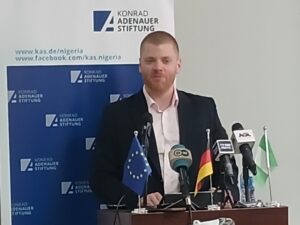
He noted that conflicts in Nigeria are often driven by a combination of religious, ethnic, political and economic factors and warned against presenting them as purely religious disputes.
“In a diverse society like ours, journalism can either build understanding or deepen mistrust. A headline can clarify or inflame. A report can shed light on complexity—or reduce it to a harmful binary,” Sprenker said.
He urged journalists to place accuracy before speed, context before sensationalism and to carefully choose language that does not turn communities into adversaries.
“Professional journalism means accuracy before speed, context before sensationalism, and careful language that does not turn communities into adversaries,” he said.
Sprenker said journalists should constantly ask whether their reports help citizens understand issues or merely reinforce existing fears and divisions.
The National Human Rights Commission (NHRC) also expressed support for the initiative, saying it would review the proposed charter and advise the Federal Government on its implementation if it aligns with Nigeria’s human rights obligations.
Director of Corporate Affairs and External Linkages at the Commission, Fatima Mohammed, said the Commission is empowered to review laws and policies affecting human rights and would assess the proposed framework against national and international standards.
“If it is brought to the Commission, we will study it as an institution and see how it aligns with the human rights bare minimum. Then we will see how we can either turn it into an advisory or advise the Federal Government on how to use it and implement it,” Mohammed said.
Meanwhile, a German political scientist and theologian, Professor Alexander Görlach, warned that the growing political use of religion is undermining democracy in many countries by excluding minorities and weakening constitutional equality.
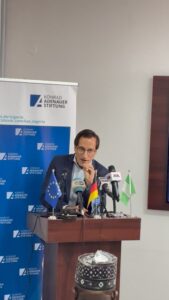
Drawing examples from several countries, he said governments that elevate religious identity above equal citizenship often erode democratic values and social inclusion.
“Whenever you overemphasise the political element of religion, you are on the slippery slope, and it is usually going against minorities,” Görlach said.
He stressed that secular states do not oppose religion but instead protect every citizen’s right to practise their faith without allowing governments to favour one religion over another.
“A secular state is not an atheist state. It allows its citizens to practise their religion, and to be a citizen you do not have to have a specific religion,” he said.
Görlach urged societies to embrace diversity, protect freedom of religion and expression equally, and build a shared civic culture where citizens are treated equally regardless of their faith or ethnicity.