By Oluwakemi Kindness
The Federal Government and the National Assembly have reaffirmed their commitment to closing the gap between Nigeria’s budgeting process and national development plans, in a bid to drive sustainable economic growth.
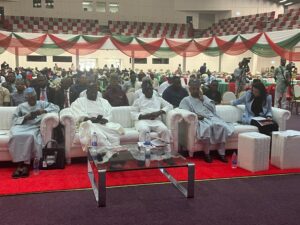
Speaking on Wednesday at the day 2 of the National Policy Dialogue in Abuja, the Minister of Budget and Economic Planning, Atiku Bagudu, stressed that effective national planning is a constitutional responsibility that must be taken seriously by all arms of government.
“National planning in Nigeria is mandated and obligated by the Constitution,”* Bagudu said.
“All those in authority… legislative, judicial and executive, have to work together.”
He noted that recent reforms by the administration were made possible through the support of the National Assembly.
“Let me appreciate the support that the committees and the National Assembly… have given to the reforms that have taken place in the last three years,” he added.
Budget Must Drive Development
On his part, Chairman of the Senate Committee on National Planning and Economic Affairs, Musa Mustapha, said Nigeria must begin to treat its budget as a key tool for development rather than just a spending document.
“We must stop treating the budget as merely a document for expenses, but rather as the primary engine for implementing our national development agenda,” he said.
He warned that the persistent disconnect between development plans and budgetary allocations has continued to slow Nigeria’s growth.
“Too often… planning and budgeting have operated in isolation, leading to inefficient resource distribution,” Mustapha stated.
10th National Assembly Pledges Collaboration
Also speaking, Chairman of the House Committee on National Planning and Economic Development, Gboyega Isiaka, said the 10th National Assembly is ready to work closely with the executive to address existing gaps.
“The 10th National Assembly is always ready to cooperate and collaborate very effectively with the President and the executive arm of government,” he said.
Isiaka added that lawmakers are seeking deeper engagement beyond oversight functions to ensure better coordination in planning and budgeting.
Focus on $1 Trillion Economy Target
The stakeholders also highlighted Nigeria’s ambition to grow into a $1 trillion economy by 2030, stressing the need for disciplined and well-aligned fiscal policies.
Mustapha said achieving this target requires a shift toward performance-driven budgeting.
“Our developmental aspirations cannot be achieved through disjointed fiscal action”, he said
The Senate committee chairman noted that ongoing reforms, including subsidy removal, foreign exchange unification and improved revenue generation, are beginning to yield results.
“Today, we are spending with purpose—investing in critical infrastructure, food security, and national development priorities,” he added