By: Julian Osamoto
The Director-General and Chief Executive Officer of the Raw Materials Research and Development Council (RMRDC), Professor Nnanyelugo Ike-Muonso, says Nigeria must stop exporting raw materials in crude form if it is to achieve real industrial growth and economic diversification.
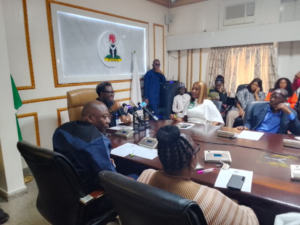
He made the statement at a media engagement held on Tuesday, at the RMRDC headquarters in Abuja, where he outlined the Council’s ongoing reforms, policy direction, and new digital infrastructure aimed at transforming the country’s raw materials sector.
According to him, the Council is pushing a 30 percent value-addition policy currently before the National Assembly, designed to ensure that raw materials are processed locally before export.

Professor Ike-Muonso said the policy would boost national revenue, generate employment, strengthen domestic industries, and build globally competitive value chains. “We cannot achieve true economic diversification if we continue to export raw materials in crude form,” he said.
He also announced a 10-year Raw Materials Roadmap (2025–2034), developed with the African Development Bank and other partners.
The roadmap targets improved raw materials mapping, 30 to 95 percent value addition, expanded partnerships, and certification of 10,000 laboratories and industrial processes.
“We now have what is arguably the most advanced raw materials database in the country,” he added, referring to a newly unveiled digital platform designed to support investment and policy decisions.
Data gaps
Also speaking, Deputy Director of Statistics and Data Analysis at RMRDC, Hamilton Chinweyin, identified poor data systems as a major cause of failed policies.
“Most policy failures today are attributed to inadequate data and evidence, and unrealistic statistics,” he said.
He explained that the Nigeria Information Statistical System for Raw Materials and Products (NISAM) was created to address this gap.
“The platform is a one-stop shop for all information concerning a particular raw material of your choice,” he said.
Dr. Chinweyin noted that the system integrates over 15 modules, enabling users to access production, pricing, capacity, and investment data from a single platform.
“Now, you can take decisions from your desk based on available data, because data is life,” he stated.
Media partnership critical
In her welcome address, Director of Corporate Affairs at RMRDC, Chinyere Nnamdi-Anum, stressed the role of the media in driving awareness and national development.
“Your consistent efforts in informing, educating, and shaping public discourse remain critical… we do not take your role for granted,” she said.
She explained that the engagement was aimed at strengthening collaboration with journalists.
“This media parley provides a platform to engage, inform, and build a more structured and sustainable partnership with the media,” she noted.
Mrs. Nnamdi-Anum also emphasized the need for collective action.
“The task of national development is a collective one… together, we can amplify the message of self-reliance, industrial growth, and economic diversification,” she said.
Reform hinges on implementation
The Council maintains that addressing weak value addition, poor data systems, and limited industrial capacity is critical to Nigeria’s economic future.
While policy frameworks and digital tools are being put in place, stakeholders say effective implementation and sustained collaboration will determine whether the country can transition from raw material exportation to value-driven industrial growth.