By Oluwakemi Kindness, Zainab Bakare
The Director-General of the National Institute for Legislative and Democratic Studies NILDS, Professor Abubakar Suliaman, has raised concerns that Nigeria’s federal character principle designed to promote inclusion is increasingly deepening divisions and weakening national cohesion.
Speaking on Wednesday at a public lecture in Abuja, Professor Sulieman described the policy as a “paradox of inclusion,” warning that frameworks meant to foster unity are instead reinforcing ethnic identities.
“What was intended as an instrument of inclusion has in practice often produced outcomes that undermine both efficiency and national cohesion,” he said.
Quota System
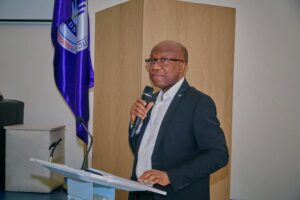
Professor Sulieman noted that while the federal character principle, enshrined in Section 14(3) of the 1999 Constitution, has broadened representation in public institutions, its implementation has triggered concerns about merit and professionalism.
He warned that rigid quota-based appointments risk encouraging mediocrity and weakening governance.
“This perception, whether real or imagined, breeds resentment, cynicism, and a retreat into primordial identities,” he stated.
According to him, growing identification along ethnic lines rather than national identity is fuelling agitation for restructuring, state policing, and resource control.
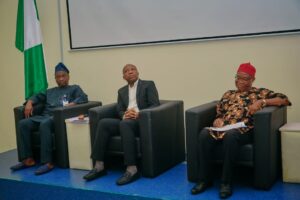
“Federalism, which should unify us, has in many ways become a mirror reflecting our differences rather than our shared destiny,” he said.
He called for a reassessment of the system, advocating reforms centred on fiscal federalism, devolution of powers, and a renewed social contract anchored on justice and fairness.
Stakeholders Push for Structural Reforms
Participants at the lecture echoed similar concerns, calling for urgent constitutional and structural reforms to tackle exclusion, over-centralisation, as well as weak enforcement mechanisms.
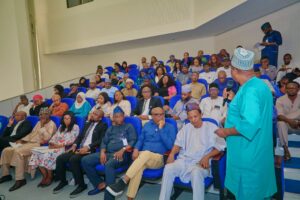
They argued that Nigeria’s federal system operates largely as a “holding together” model, struggling to balance unity with genuine nation-building.
“Nigerian federalism is neither fully building the nation nor effectively empowering its diverse ethnic groups,”.
Some participants linked rising insecurity and civil unrest to gaps in inclusivity as well as equitable governance.
“If our federal system were truly inclusive, many of these crises would not exist,” another participant said.
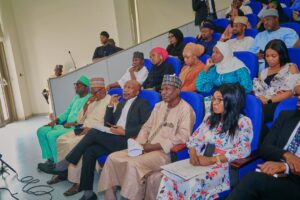
Calls were also made for constitutional amendments to enable citizens directly enforce federal character provisions, an approach seen in countries like Ghana and Kenya.
Concerns were raised over the independence of the Federal Character Commission, particularly provisions requiring presidential approval for enforcement actions.
“How can an agency meant to ensure fairness be subject to discretionary approval?” a stakeholder queried.
Participants further urged the National Orientation Agency to expand civic education efforts beyond election cycles to strengthen national consciousness.
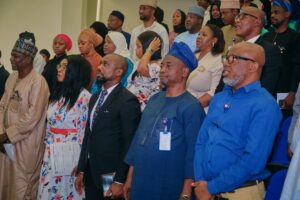
Research Culture Reforms at NILDS Highlighted
On his part, the Director of Democracy and Governance at NILDS, Chris Nagara, commended the institute’s leadership for improving its research culture and expanding opportunities for scholars.
He said researchers who were previously excluded from institutional platforms are now actively contributing to policy discourse.
“When I came to NILDS, some of us were not even considered qualified to present papers. But this DG created the opportunity for us to try, make mistakes, and learn,” he said.
Practical Solutions
The Stakeholders called for evidence-based reforms, including reducing emphasis on “state of origin,” promoting inclusivity, and ensuring fairness in resource distribution.
The NILDS DG reaffirmed the institute’s commitment to supporting the National Assembly with research-driven policy options aimed at strengthening governance and national unity.